Publications
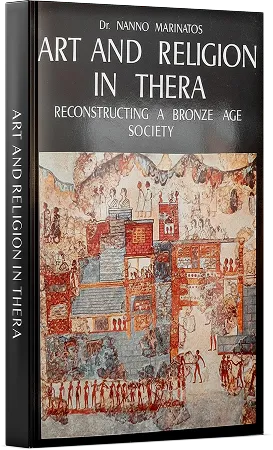
Art and Religion
in Thera
Reconstructing a Bronze Age Society
This is a book about wall paintings and the function they fulfilled in the Bronze Age society of Akrotiri, Thera. The author discusses the frescoes in their architectural setting and in relation to the objects found in the rooms and buildings. This method enables her to explore the symbolism of the art and to reconstruct actual ceremonies. The paintings also reveal attitudes towards religion and the Therans’ basic confidence in the permanance and unchanging order of nature.
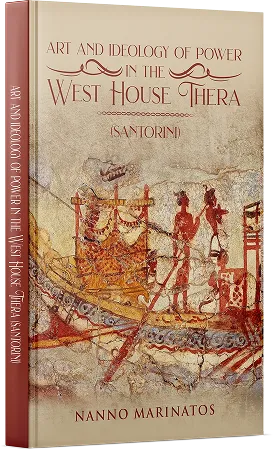
Art and Ideology of Power in the West House Paintings Thera
Many of the paintings in the West House at Thera (Santorini) (c. 1500 BCE) can be deciphered as ideological narratives, which reflect the power of Knossos, Crete. They are here reinterpreted as blending with the religious content: the cult of the solar goddess of Crete and Thera. Art and ideology fuse to forge a stunning visual vocabulary of power and worship.
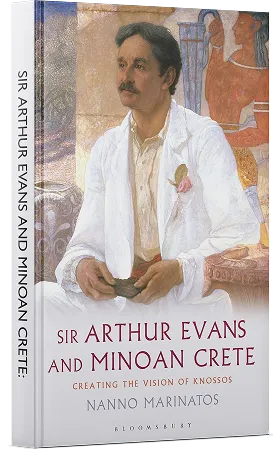
Sir Arthur Evans and Minoan Crete
Creating the Vision of Knossos
Before Sir Arthur Evans, the principal object of Greek prehistoric archaeology was the reconstruction of history in relation to myth. European travellers to Greece viewed its picturesque ruins as the gateway to mythical times, while Heinrich Schliemann, at the end of the nineteenth century, allegedly uncovered at Troy and Mycenae the legendary cities of the Homeric epics. It was Evans who, in his controversial excavations at Knossos, steered Aegean archaeology away from Homer towards the broader Mediterranean world. Yet in so doing he is thought to have done his own inventing, recreating the Cretan Labyrinth via the Bronze Age myth of the Minotaur. Nanno Marinatos challenges the entrenched idea that Evans was nothing more than a flamboyant researcher who turned speculation into history. She argues that Evans was an excellent archaeologist, one who used scientific observation and classification. Evans’s combination of anthropology, comparative religion and analysis of cultic artefacts enabled him to develop a bold new method which Sir James Frazer called ‘mental anthropology’.
It was this approach that led him to propose remarkable ideas about Minoan religion, theories that are now being vindicated as startling new evidence comes to light. Examining the frescoes from Akrotiri, on Santorini, that are gradually being restored, the author suggests that Evans’s hypothesis of one unified goddess of nature is the best explanation of what they signify. Evans was in 1901 ahead of his time in viewing comparable Minoan scenes as a blend of ritual action and mythic imagination. Nanno Marinatos is a leading authority on Minoan religion. In this latest book she combines history, archaeology and myth to bold and original effect, offering a wholly new appraisal of Evans and the significance of his work. Sir Arthur Evans and Minoan Crete will be essential reading for all students of Minoan civilization, as well as an irresistible companion for travellers to Crete.
It was this approach that led him to propose remarkable ideas about Minoan religion, theories that are now being vindicated as startling new evidence comes to light. Examining the frescoes from Akrotiri, on Santorini, that are gradually being restored, the author suggests that Evans’s hypothesis of one unified goddess of nature is the best explanation of what they signify. Evans was in 1901 ahead of his time in viewing comparable Minoan scenes as a blend of ritual action and mythic imagination. Nanno Marinatos is a leading authority on Minoan religion. In this latest book she combines history, archaeology and myth to bold and original effect, offering a wholly new appraisal of Evans and the significance of his work. Sir Arthur Evans and Minoan Crete will be essential reading for all students of Minoan civilization, as well as an irresistible companion for travellers to Crete.
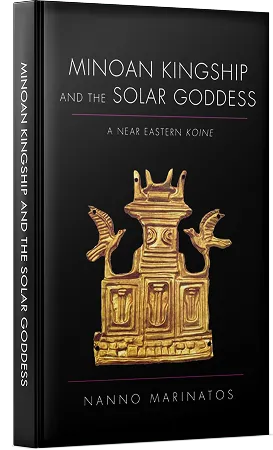
Minoan Kingship and the Solar Goddess
A Near Eastern Koine
Ancient Minoan culture has been typically viewed as an ancestor of classical Greek civilization, but this book shows that Minoan Crete was on the periphery of a powerfully dynamic cultural interchange with its neighbors. Rather than viewing Crete as the autochthonous ancestor of Greece’s glory, Nanno Marinatos considers ancient Crete in the context of its powerful competitors to the east and south.
Analyzing the symbols of the Minoan theocratic system and their similarities to those of Syria, Anatolia, and Egypt, Marinatos unlocks many Minoan visual riddles and establishes what she calls a “cultural koine,” or standard set of cultural assumptions, that circulated throughout the Near East and the eastern Mediterranean at the time Minoan civilization reached its peak. With more than one hundred and fifty illustrations, Minoan Kingship and the Solar Goddess delivers a comprehensive reading of Minoan art as a system of thought.
Analyzing the symbols of the Minoan theocratic system and their similarities to those of Syria, Anatolia, and Egypt, Marinatos unlocks many Minoan visual riddles and establishes what she calls a “cultural koine,” or standard set of cultural assumptions, that circulated throughout the Near East and the eastern Mediterranean at the time Minoan civilization reached its peak. With more than one hundred and fifty illustrations, Minoan Kingship and the Solar Goddess delivers a comprehensive reading of Minoan art as a system of thought.