The sea was not merely a background for movement in the Minoan world. It was a stage upon which authority, identity, and ideology were displayed with precision and intent. In Art, Religion, and Ideology in the West House Paintings of Thera (Santorini) by Nanno Marinatos, ships are revealed as more than functional vessels. They emerge as powerful symbols that communicate dominance, unity, and cosmic order.
The fleet depicted in the West House frescoes is organized, purposeful, and richly detailed. These are not casual representations of travel or trade. The ships are decorated with elaborate decorations, including garlands, pendants, and symbolic motifs that mirror elite adornment. This visual connection between personal jewelry and maritime imagery transforms each vessel into an extension of authority. The ship itself becomes a statement of power.
Among these vessels, the admiral’s ship stands apart. Its distinctive decoration signals hierarchy within the fleet. Elements such as floral motifs and symbolic imagery are not simply decorative. They function as markers of identity and control. The presence of such details indicates that leadership was not only recognized through position but also through visual language. The admiral’s ship embodies command, projecting influence across both sea and society.
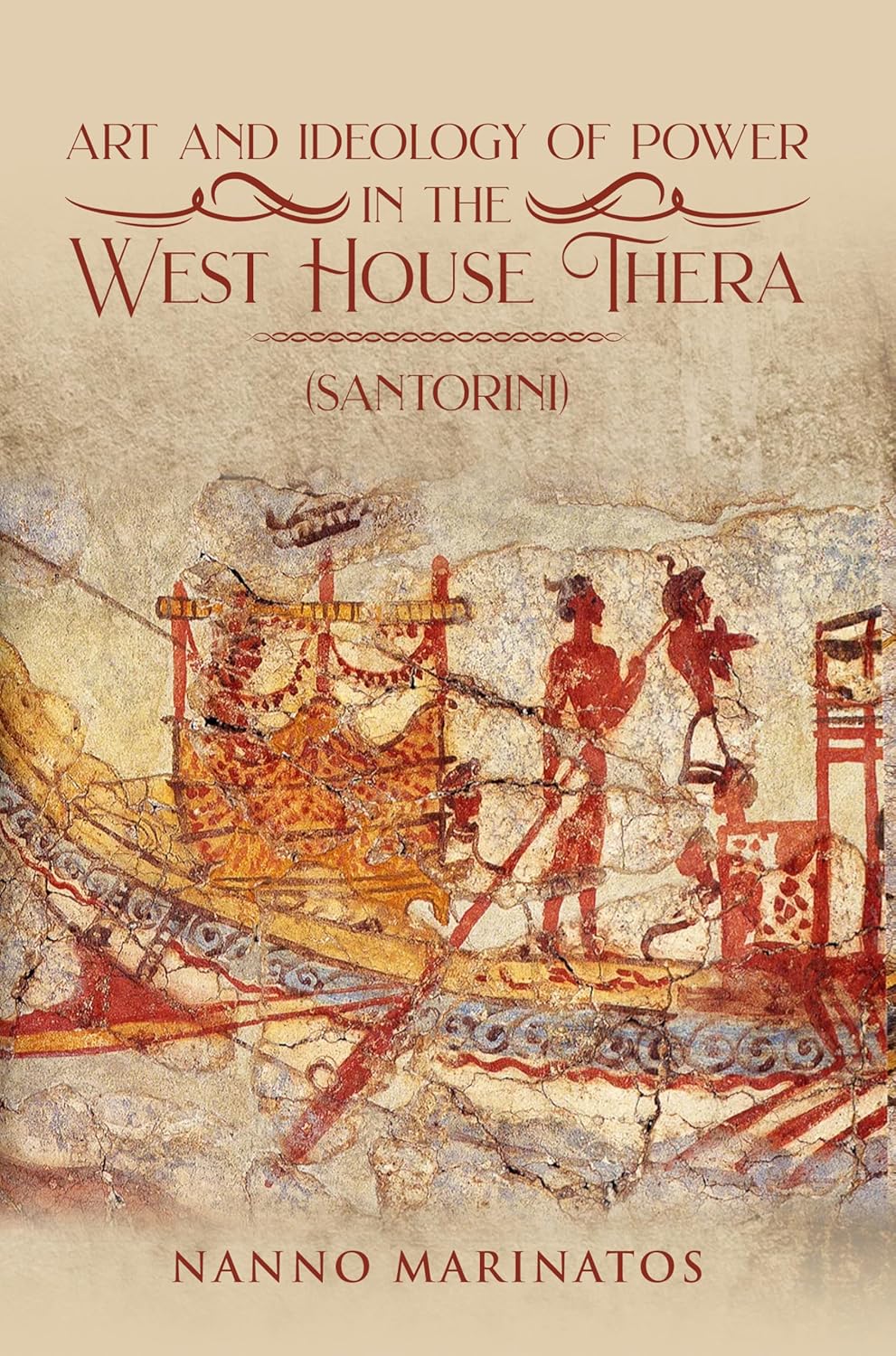
The imagery also suggests a unified naval force operating under a shared ideological framework. The consistency of symbols across ships points to a centralized system of meaning, likely connected to Knossian influence. This unity is not accidental. It reflects a bigger strategy of integration, where visual symbols reinforce cohesion across regions. The fleet becomes a moving representation of a wider cultural and political network.
Naval power in this context is closely tied to ideology. The ships do not merely patrol or transport. They communicate messages of control, success, and legitimacy. Scenes of coordinated movement and disciplined formation emphasize order, contrasting sharply with depictions of defeated or chaotic figures. This visual contrast reinforces the authority of the fleet and the system it represents.
The inclusion of symbolic elements such as the sun further deepens this interpretation. The sun, positioned prominently within the imagery, is associated with divine authority and cosmic balance. Its presence on the ship connects naval power to a higher order, suggesting that the actions of the fleet are not only political but also sanctioned within a broader spiritual framework. Power is therefore both earthly and divine, grounded in visible strength and supported by symbolic meaning.
The portrayal of warriors aboard the ships adds another dimension. These figures are not passive passengers. They are equipped, organized, and prepared for action. Their presence indicates that the fleet serves a military function alongside its symbolic role. The combination of martial readiness and elaborate decoration creates a dual message. The fleet is capable of force, yet it also embodies refinement and cultural sophistication.
This balance between aggression and order is central to understanding Minoan naval ideology. The fleet does not rely solely on displays of violence. Instead, it integrates visual symbolism, ritual elements, and structured representation to project authority. Power is communicated through a combination of strength, organization, and shared cultural language.
Marinatos’s work brings clarity to this complex system. By examining the details of the frescoes, she reveals how naval imagery operates as a form of communication. Each element, from the arrangement of ships to the symbols they carry, contributes to a larger narrative of control and integration. The sea becomes a domain where ideology is enacted and displayed.
Art, Religion, and Ideology in the West House Paintings of Thera (Santorini) offers a compelling perspective on this subject. It moves beyond surface interpretation to uncover the deeper meanings embedded within the imagery. For readers interested in ancient civilizations, maritime history, and symbolic expression, the book provides a rich and insightful exploration.
Through its analysis, it becomes clear that Minoan naval power was not defined solely by movement across water. It was defined by the ability to project identity, enforce order, and sustain a unified vision of authority.
Available now on Amazon: https://www.amazon.com/dp/B0GGKK64DM/